

The average knowledge worker spends 20% of their day looking for information. That’s one full day per week, wasted, because somebody didn’t write something down. Sometimes that somebody is you and it definitely used to be me!
I’m going to say something that might sound dramatic but I believe it completely: the ability to take and organize notes is a top 5 skill in life. Not a top 5 “productivity hack.” A top 5 life skill. It separates people who can learn, retain, and act on information from people who try to keep everything in their head and fail spectacularly at it.
In fact, the people that brag the most about their memory seem to be the ones who are the worst at this - zero self awareness of the problem - probably because they forgot they even made a promise or needed to do something! It’s actually a major problem, especially in a world that has exponentially more information every year. We are drowning in tasks and information and if you don’t have a system, I have bad news for you.
The Cost of Not Writing Things Down
Not writing things down is low agency behavior. Full stop.
You had a great idea in the shower or on a walk. Gone. Someone told you a name at a networking event. Gone. You made a commitment and forgot about it by lunch. Trust me, your boss, your client, your spouse noticed, even if you didn’t.
This gets worse as you age, by the way. Your memory isn’t getting better. And every time you drop the ball on something you should have written down, you’re making a withdrawal from your trust account. People stop giving you opportunities because they can’t rely on you to remember what was discussed, what was promised, what was decided.
Think about the people in your life who always seem to have it together. Who remember your kid’s name, who follow up on the thing they said they’d do, who can pull up a document or a detail from their phone in five seconds flat. Those people aren’t geniuses. They write things down.
Da Vinci kept notebooks. Marcus Aurelius kept a journal. Richard Branson is famous for always carrying a notebook. Vannevar Bush proposed the concept of a personal memory system called the “Memex” back in 1945. This isn’t some trendy productivity thing. It’s a fundamental human competency that most people are terrible at.
The lost ideas. The forgotten promises. The repeated mistakes. The deals that slipped because you couldn’t recall the details. All of it is compounding against you, every single day, because you trust your brain to do a job it was never designed for.
The Fix Is Embarrassingly Simple
Here’s the good news: you don’t need a complex system. You don’t need to become a Notion wizard or buy a $400 planner. You need one free app, a few habits, and about 15 minutes of setup.
Pick one app and put it everywhere.
Apple Notes if you’re in the Apple ecosystem. Simplenote if you use both Mac and PC (or just PC). The app genuinely does not matter, if you have a better one use it. What matters is speed and zero friction. It needs to be on every device, synced, and searchable.
On your phone: put it on your home screen, within thumb’s reach. You should be able to pull your phone out of your pocket, open the app, and start writing or dictating (see below about that) in under 3 seconds.
On your desktop: keep it pinned open to the left of your browser window. Not buried in a tab. Visible. Like this:
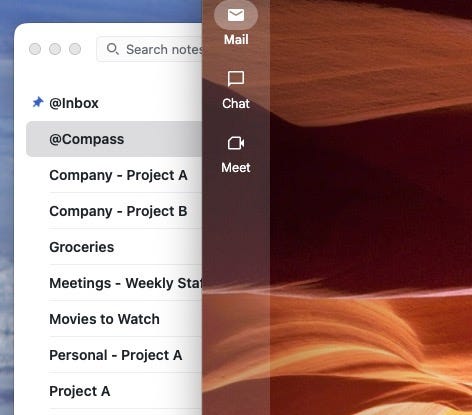
I can bounce from an email or any tab of work straight into my notes. I’ve done this for years and it’s one of the simplest things I do that consistently blows people away. I can find a note, a checklist, a file reference in seconds while someone else is still hunting through folders or tabs.
Create an @Inbox note.
See the screenshot above. Name it with the @ symbol so it sorts to the top of your note list. This is your quick capture note. Hotel room number. A name or phone number someone just told you. A random idea at 2am. A grocery item. Anything that needs to get out of your head and into a system goes here.
Process this note once a week during your weekly review. Move things where they belong or delete them. This one habit alone will change your life because it eliminates the most common excuse for not writing things down: “I didn’t know where to put it.” Put it in @Inbox. Done.
Name things so you can find them.
Use simple prefixes. “Project - Website Redesign.” “Meeting - Board Call April.” “Reference - Insurance Info.” When you name things consistently, search becomes incredibly powerful even without folders.
Speaking of folders: you probably don’t need them. If you insist, two folders cover almost everything. Projects (stuff you’re actively working on) and Reference (stuff you want to keep for later). That’s it. Create an Archive subfolder inside Reference for things you’re done with but might need someday. I have thousands of notes and use only those 2 folders, search for everything else. Don’t overthink this.
Write to your future self.
This is the one most people get wrong. Don’t just write “call Dave.” Write why you need to call Dave, what happened last time, what you need from him. Add links. Add context. Your future self has no idea what present-you was thinking unless you tell them.
One of the most powerful things I do: I keep one running note for each recurring meeting. Every time we meet, I add new notes at the top. I now have a complete history of every discussion, every decision, every commitment. When someone says “we never agreed to that,” I can pull it up in 10 seconds. When I need to recall what we discussed three months ago, it’s right there. This saves hundreds of hours over time and builds an insane level of trust with the people you work with. The people you work with will be astounded at your recall and, especially if you manage a team, know that you will be holding them accountable for promises because it was written down and agreed to previously.
Use your voice.
This is the part most people are sleeping on. You speak 2-3x faster than you type. Modern voice dictation tools aren’t the janky speech-to-text of 10 years ago. They use AI to clean up your words, cut filler, add punctuation, and format things properly.
I use an app called Monologue and it’s become a core part of how I work. It learns your vocabulary and writing style, works in any app on your phone or computer, and turns spoken words into clean text. It even has a Notes feature for recording walks and meetings, then giving you a searchable transcript and summary. There’s also a whisper mode for when you’re in a coffee shop and don’t want to be that person dictating at full volume.
Other solid options: Wispr Flow works on Windows and Mac. AudioPen is great for capturing quick voice notes on your phone and turning them into structured text.
The point isn’t which app you pick. The point is that voice capture kills the number one excuse for not taking notes: “I didn’t have time.” You always have time to talk. Walk down the street and dictate a note. Sit in your car after a meeting and spend 30 seconds capturing the key points. It’s that fast.
Think of it as a system, not a notebook.
Your notes app isn’t just a place to scribble things. When combined with your task manager, calendar, and cloud drive, it becomes something much more powerful. A personal knowledge system, a “Memex,” that stores your goals, ideas, checklists, project plans, meeting notes, and anything else you need to work on or remember.
I can walk into any meeting, pull out my phone, and within seconds have the exact information I need. Other CEOs, friends, they’re astonished by this. It’s not magic and it’s not a great memory. It’s a simple system that I actually use.
Start Here
Don’t try to build the perfect note system this weekend. Open your notes app right now and create one note called @Inbox. Start putting things in it today. Process it this weekend.
That’s all. One note. One habit.
See what happens when you stop trusting your brain to do a job it was never designed for.
I teach the complete Memex system and note-taking workflow inside Zorga, my operating system for founders and high-agency people. If this article made you realize your current system (or lack of one) is costing you, that’s a good place to start.
Feedback: Like or dislike this article? Leave a comment, hit reply or submit anonymous feedback here.