

I mention my course, Zorga, a lot because I think it’s the best productivity and life improvement course out there. But I could be biased of course!
Anyway, I have a few quick announcements:
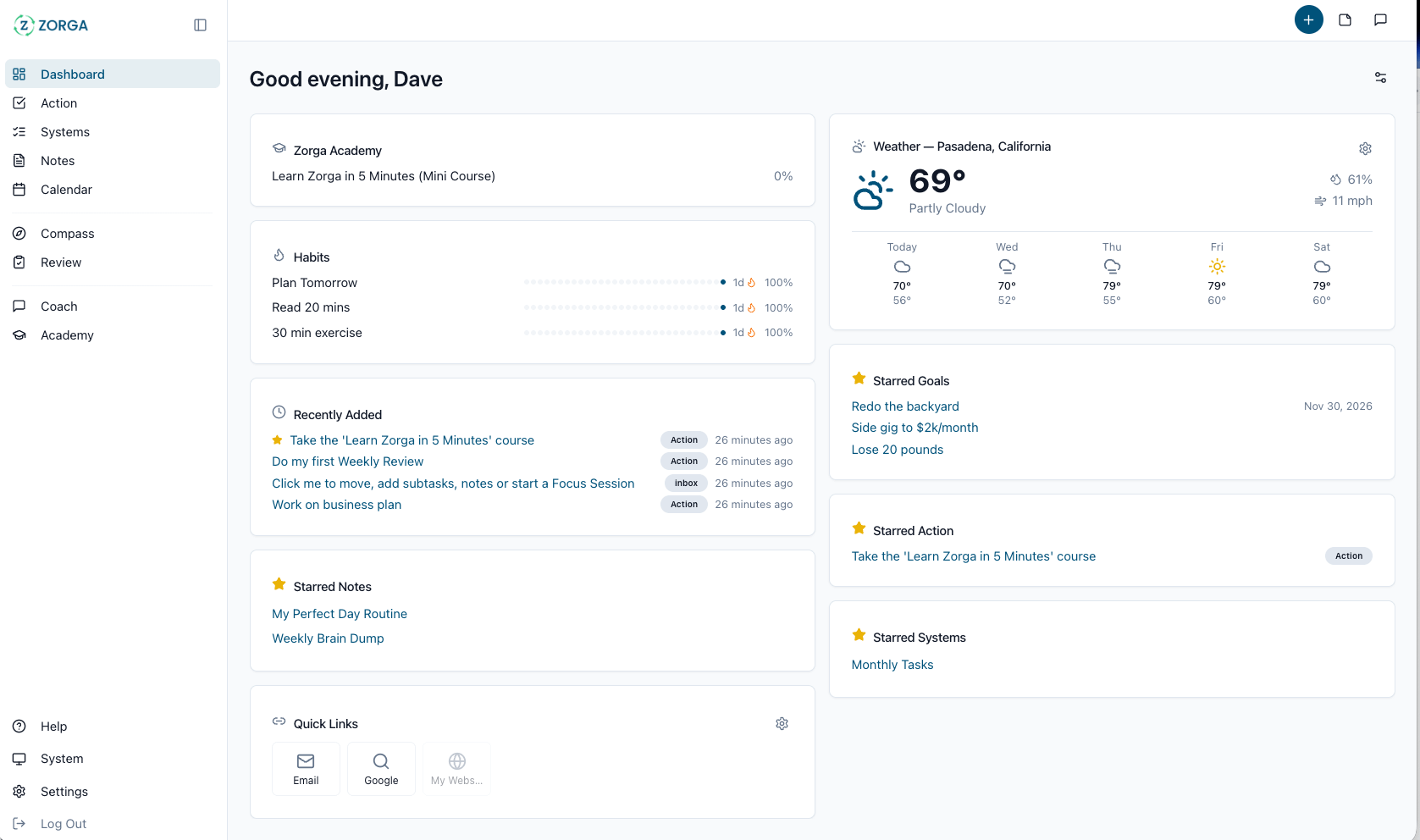
Zorga is now a full-fledged web application, built by my long-time developer and I. It’s an app meant to help you run your life and your business, based on Zorga principles and best practices. Read more about the app on our website here: https://www.organize.io/ - there’s a 14 day free trial, no credit card required.
Also, in addition to the app I’ve been working on a business version of Zorga I simply call the Business OS.
The Zorga flywheel of Direction, Action, Feedback and Optimization actually works perfectly for business as well. And since I spent most of my life building businesses, I wanted to make a system for business owners to manage and improve their business as well.
Below is the intro and the fist 3 lessons of Business OS. I’ll send more about the course when it’s finished in a few weeks.
Business OS
Hello and welcome to the Zorga Business OS. I’m Matt Knee, creator of Zorga and author of Startups Made Simple. If you’re here, you run a business or you’re about to, and you want it to run better. You’re in the right place.
Let me tell you why I built Zorga and the Business OS specifically.
I founded an Inc. 5000 company from my apartment with zero funding and eventually sold it for millions. Along the way I made almost every mistake a business owner can make. I worked 60+ hours a week on the wrong things. I hired people I shouldn’t have and kept them too long. I let my business run me instead of the other way around. As a bonus, this ultimately wrecked my health as well. The content in this course is what I wish someone had handed me on day one.
Business OS is the operating system your business didn’t come with. Most owners run their company the way most people run their lives, which is to say with no system at all. Everything lives in their head. Every decision goes through them. Every fire gets put out personally. That works until it doesn’t, and then the business either stalls or burns the owner out.
This course is for owners who want a real system. Whether you’re a solopreneur, you have a small team, or you’re building toward something much bigger, the fundamentals are the same. Strategy, scoreboard, operating rhythm, delegation, playbooks. Fortune 500 companies run on these same pieces, they just have more of them. Start with the basics and you can scale as far as your ambition takes you.
By the end, you’ll have a one-page strategy, a scoreboard that tells you if the business is alive, a weekly operating rhythm, an issue list that solves problems faster than anything I’ve ever used, and your first playbook. You’ll know how to delegate without things bouncing back to you, how to hire when the time comes, and how to actually use AI and automation without wasting hundreds of hours on tools that don’t pay you back.
Two quick notes before we start.
First, Business OS complements the Zorga System, it doesn’t replace it. Your business is run by you, so if your health, focus, and clarity are a mess, no amount of business systems will save you. If you haven’t gone through Zorga Personal yet, I’d do that first or run them in parallel.
Second, the whole course lives inside the Zorga app. Each lesson plugs directly into tools you’ll use every day: the Business Compass for your strategy, the Scoreboard for your numbers, the Weekly Review for your operating rhythm, the Shared Notes (wiki) for your playbook. You don’t need any other software to run this system, that’s why I built Zorga to manage both your business and your life in one place.
One warning before we begin. Don’t try to install everything in a weekend. The last lesson gives you a 30-day checklist. Business OS is a system you install over a few weeks and then run for years.
Ready? Onward!
The Flywheel
Before we go any further, I want to show you the one idea that makes everything else in this course make sense. If you get this, the rest is just implementation details.
Every business, every single one, runs on the same flywheel: Direction, Action, Feedback, Optimization. You figure out where you’re going and why. You do it. You look at what happened and adjust. Then you make it bigger, faster, and easier to repeat. Then you run it again.
That’s it. That’s business. Apple does this. Your local plumber does this. You do this right now, whether you realize it or not. The only question is whether you’re running the flywheel intentionally or accidentally. Most owners run it accidentally, which means they plan once a year when they feel guilty, execute in a reactive panic, learn almost nothing because they never stop to look, and never get scale because the first three steps are a mess. Business OS makes the loop intentional.
If you’ve gone through Zorga Personal, this flywheel will be familiar. Personal Zorga runs on DAFO as well: Direction, Action, Feedback, Optimization. It’s the same loop, just applied to your life instead of your business. That’s not a coincidence. A business is run by a person, and the same principles that make a person effective make a business effective. If you know DAFO, you already know Business OS at a conceptual level. We’re just going to apply it to your company.
NOTE: In this course, we rename Feedback to “Grow” and “Optimization” to “Systemize” to give those sections more familiar business terms but the concept is the same.
Here’s why I call it a flywheel. Most business frameworks treat these as phases you go through once, like you plan in January, execute all year, learn in December, and scale next year. That’s nonsense and way too slow. In reality, the flywheel is always running in the background. You set Direction once or twice a year, review it lightly each quarter, and glance at it during your Weekly Review to make sure this week’s work actually connects to it. Action is daily, but once your rhythm is installed, it runs itself. Feedback happens naturally when you take a few minutes on Friday to look at what worked. Optimization happens whenever you notice something is broken or you’re doing twice and turn it into a system. The flywheel is a background operating system that keeps you pointed in the right direction with very little overhead once it’s set up.
The four modules in this course map directly to the flywheel. Direction is how you plan. Action is how you execute. Grow is how you feed the machine, which is the best form of feedback because the market tells you the truth fastest. Systemize is how you optimize and scale, turning what works into a machine that doesn’t depend on you.
Note that you don’t have to run all four perfectly. Most businesses are broken in one or two of these and fine in the others. A solopreneur might be great at Action but have no Direction. A more established business might have a solid plan but no systems, so everything still runs through the owner. As you go through this course, notice which parts of the loop are weakest in your business. That’s where you’ll get the biggest return.
The Three Jobs
Running a business can feel like you have a thousand things to do. Strategy, hiring, marketing, operations, finance, customer service, product, and on and on. It’s overwhelming, and this is why most owners just react to whatever’s loudest that day. Here’s a much easier way to think about it.
Every business, no matter how big or small, comes down to just three jobs. Build the machine. Feed the machine. Improve the machine. That’s it. Every task you do as an owner belongs to one of those three jobs. Keep that in mind and the complexity melts away.
Build the machine. This is your Direction and your systems combined. You figure out what you’re doing, who you’re doing it for, and how you’ll win. Then you turn that into something repeatable. The machine is the collection of systems and people that turns your strategy into output without you personally touching every step. Businesses with a real machine can grow. Businesses where the owner is the machine are capped at one human’s output, and that’s a hard ceiling.
Feed the machine. You can have the most beautifully designed machine on earth, but if nobody’s feeding it with customers, it’s a very expensive hobby. Feeding the machine means generating demand, closing sales, and keeping customers happy so they keep coming back and recommending your business to others. Great news here: in this day and age, there are more ways than ever to reach customers, and most of them are cheap or free if you know what you’re doing. We’ll cover that in the Grow module.
Improve the machine. This is your weekly operating rhythm, your issue list, your scoreboard. The machine you build today won’t be the machine you need next year. Customers change. Markets shift. You find better ways to do things. Improvement is what keeps the machine getting faster, smoother, and more profitable over time. The best part is that once you install the rhythm, improvement basically happens on autopilot.
Most owners are heavily unbalanced across the three. Some spend 90% of their time feeding the machine because sales feels urgent, and they never build anything repeatable. Others obsessively build systems for a machine that has no customers. Others get stuck tweaking endlessly and neither build nor feed. Notice which one is you. That’s probably your biggest bottleneck right now, and fixing it will produce the biggest return on your time.
Business OS makes sure all three jobs get done.