


Your doctor spends about 10 minutes with you, can’t remember your name without looking at the chart, and is part of a system that accidentally kills up to 250,000 Americans per year.
Seriously, look it up, hundreds of thousands dead each year. The systems kills so many there’s an entire category of death called “iatrogenic” which is basically doctor/hospital caused deaths. This makes it possibly the 3rd leading cause of death behind heart disease and cancer.
I don’t bring this up to scare you or to dunk on doctors. Doctors aren’t evil but many are trapped in a broken system. Malpractice fear has driven “defensive medicine” (over-testing, over-prescribing), the HMO’s only let them get 10-15 minutes per patient and they’re incentivized to treat, not prevent.
Frankly, patients demand a lot of this. Nobody wants to hear “you need to lose weight and exercise more” or “you have a virus and there’s nothing you can do but wait it out.” They want a pill or other quick fix to make it go away.
I should know. At one point I was near 240 pounds and on 5 medications. That’s when I decided that the current system isn’t working at all. You get prescribed a drug, sent on your way, and nobody connects the dots between your 3 different specialists. Your cardiologist doesn’t talk to your endocrinologist. Your PCP doesn’t know what supplements you take. Nobody is looking at your full picture.
You’re the only person with the incentive and the ability to see your complete health picture. But most people don’t, because they were taught “trust the doctor.” The problem is there are now multiple doctors, many more tests and data, more complexity and the various systems don’t really communicate with each other.
The solution is you have to become the CEO of your own health. The good news: this is simpler than you think. You don’t need a medical degree. You need a document, a few tools, and about an hour of setup.
Here’s the system.
Keep a Health Tracker
There are only a handful of metrics that are very important to know and you should have one note (or ideally a spreadsheet) and it should be accessible from your phone. In this document you will have:
Your numbers (see next section)
Current medications and dosage
Supplements
Allergies
Family history
Test results (or a folder with them all kept in one place)
Bring this to every appointment (or print it out). This alone will prevent duplicate tests, conflicting prescriptions, and the “start from scratch” problem every time you see a new provider or have to go to some random ER or urgent care (where they won’t have your records). Make sure to show it to any doctor who wants to put you on a new medication.
Know Your Numbers
In Zorga (the life operating system I created), I have a tool called The Health Optimizer, I provide a list of exactly what things you should track:
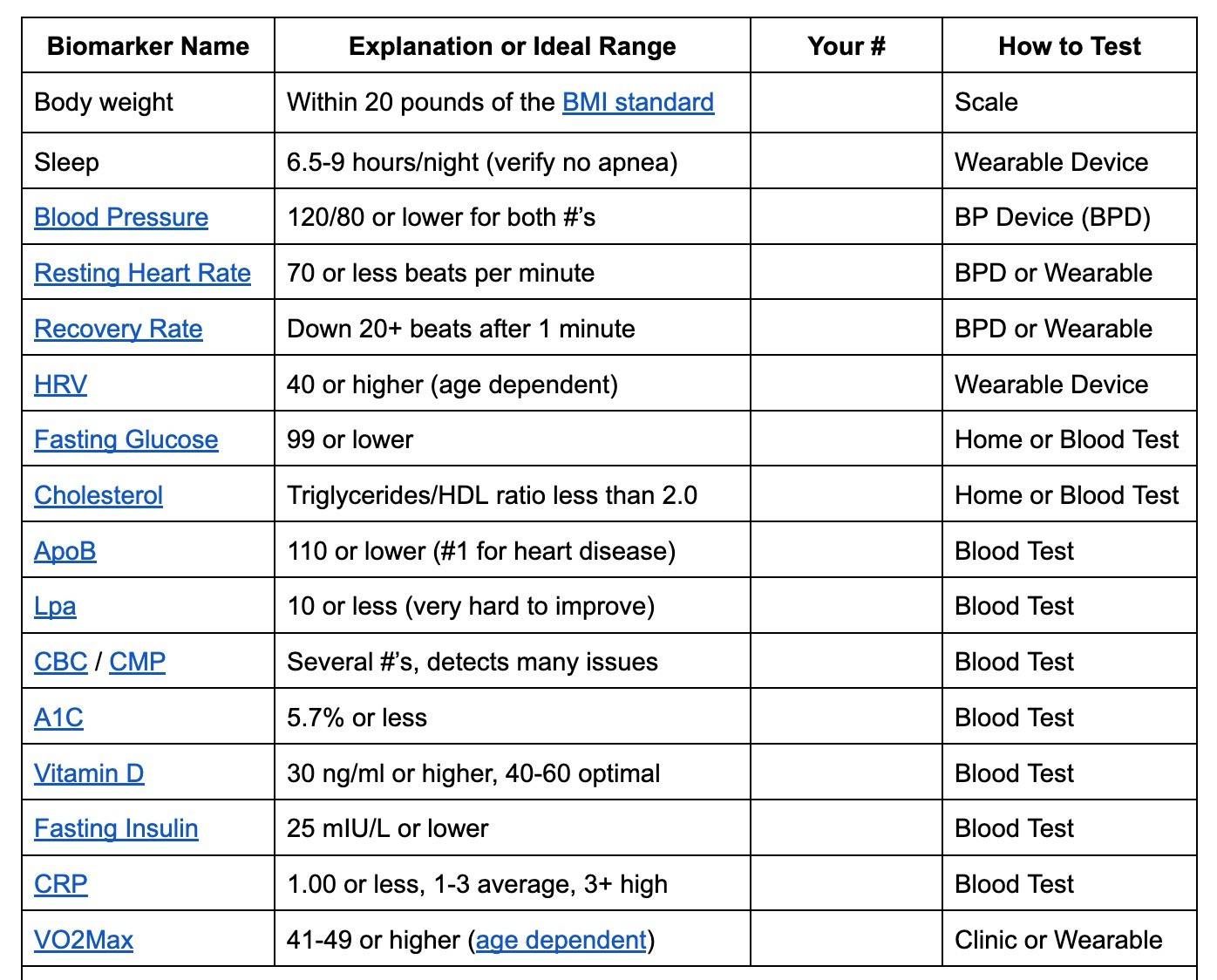
Note that you can measure many of these at home or order bloodwork online (without a doctor - search “blood work online”) at places like:
I know those metrics above have weird names but what’s interesting is almost all of them are related to either body weight, sugar or inflammation. Extra weight puts stress on your system (especially heart and arteries, leading to high blood pressure). High blood pressure and inflammation damages the pipes, cholesterol patches the damage and you get blockages (in the heart, legs, brain, etc.).
Sugar and processed food further damages the pipes, which is why Type 2 diabetes is so deadly. This is an oversimplification but the model is accurate. The main thing is to keep your body weight down, don’t consume junk (especially excess sugar or inflammatory foods) and exercise.
Get a Wearable Device
I know these devices can get out of hand (Whoop, Fitbit, Oura Ring, Garmin, etc.) and even make some of us neurotic, constantly analyzing every little thing. But I think they’re valuable for at least a few months so you can get a baseline on your stats and make sure you’re sleeping well. Sleep, as I’ve discussed, is critical to almost everything and most people don’t sleep as well as they think or have a hidden issues like sleep apnea which causes a lot of health problems.
These devices can give you your HRV (Heart Rate Variability) which is one of the better indicators of overall health and recovery. Over time, HRV and other basic metrics from these wearables like resting heart rate will tell you a lot more than a single doctor visit. There are some cheap ones on Amazon if you just want to try out the basics.
Track Your Nutrition with Cronometer
Cronometer.com is a free website/app where you can enter what you eat and it will give you calories, macronutrients and the vitamin/mineral content. I know what you’re thinking: here we go, I’m going to spend hours logging everything I eat. No, just log a few typical days of eating (they have all the major types and brands of food, restaurants, etc.). Most of us eat the same 5-10 meals so this isn’t as hard as you think. I think you’ll probably be shocked at what you’re deficient in, I certainly was.
Most Americans are deficient in magnesium, Vitamin D, potassium, Omega-3s and several other vitamins and minerals. I want to convey how your life can change if you simply supplement a few deficiencies. Magnesium alone was such a game changer to me that I will never stop bringing it up to people who have blood pressure, sleep, anxiety or migraine issues. A dramatic life improvement. Same with potassium and Vitamin D.
The point is that Cronometer takes the guesswork out of eating properly or supplementing. A lot of people just randomly take vitamins and that can actually backfire, which I’ll go over below. Spend a few minutes messing around with the free app on your phone and you’ll see what I’m talking about.
Unlock Your Genetics
The #1 thing I’ve done for my health (and some friends and family) in the past year is running my genetics through a service, then having artificial intelligence interpret those results and make recommendations. Remember, modern AI is trained on the most advanced medical knowledge and is making diagnoses on par with real doctors at this point.
To do this, you need to first have your genetics analyzed. 23andMe or Ancestry.com are the 2 most popular. Then download your “raw data file” from them. Then go to Nutrahacker.com, upload the data file and you can get a “basic” report for free or an advanced one for like $40. I recommend the advanced one.
This report will detail various mutations that are probably causing you issues. I found out I couldn’t process folate properly (MTHFR), my cortisol never shuts off (NR3C1), I can’t clear dopamine or adrenaline fast enough (slow COMT; meaning I’m constantly wired) and the stuff that calms all of that down (GABA) is also underpowered.
Needless to say, some simple interventions based on that report have had a dramatic improvement on my life. And doctors, for the most part, have no idea or don’t test for a lot of this stuff.
Let AI Connect the Dots
Next we leverage AI. I recommend ChatGPT, Claude or Google Gemini. This will be more powerful if you can attach a copy of your Health Tracker, the Nutrahacker report and any blood work you may have. Don’t worry, the AI can sort it all out and make sense of it.
Then you can simply enter one of the prompts below:
Prompt 1 (if you have test results/genetic reports):
You are a health and nutrition expert. Analyze the attached genetic or functional test report(s). First, give a plain English summary with the 3-5 most impactful diet, lifestyle, and supplement recommendations. Then provide a deeper dive with explanations of each finding, why it matters, and additional recommendations, clearly flagging high-priority issues separately from optional optimizations.
Prompt 2 (if you have nothing yet and just want to start):
You are a health and nutrition expert. Ask me targeted questions, one at a time, to find the best lifestyle, exercise, supplements and diet for me. Cover my health issues, profile, goals, current routine, lifestyle, and constraints. Then give evidence-based recommendations, prioritizing the top actions with the biggest impact.
NOTE: Make sure to list any medications you’re on in these discussions. The AI may recommend lots of interventions and a laundry list of supplements. Start with your biggest issues first, one at a time and work on those.
Supplement Wisely, Not Randomly
As I mentioned above, you almost certainly have some kind of deficiency and should be supplementing (or adjusting diet). However, most people are simply supplementing wrong or in a haphazard way and that can cause problems.
For example, I mentioned Vitamin D. I knew I was deficient from blood work so I simply started taking it. It took me a while to understand this, but my background level of anxiety kept creeping up higher and higher. Ultimately I figured out that the type and brand of D I was taking was causing this. I lost a year of anxiety to this so I want you to understand that supplementing can backfire.
So, the lesson is: test first or at least verify through Cronometer you’re not getting enough of something. Try to add only one thing at a time and make sure you’ve researched the correct dose. This is why I typically don’t recommend multivitamins unless they’re very low dose (many are huge megadoses) and very high quality (many multis use cheap ingredients). So add one at a time and track how you feel.
Work Around the System When Needed
You can probably sense my frustration with the medical field. This is due to not only my own experience but the experiences of many loved ones. All I will say about this is that there are very stubborn doctors who do not keep up with modern treatments and technology.
If this is the case, my recommendation is to change doctors. I highly recommend a “direct primary care” doctor (or “concierge doctor” if you can afford it) that you can do tele-visits with and text for questions, refills, etc. - none of this “wait 4 weeks for an appointment” nonsense. You want to work with a doctor who actually talks with you and listens.
Worst case, there are many services online where you can get a doctor on demand and they can help you with the issue you’re having. Do online searches for any condition and you’re likely to find one of these newer services. Certainly blood and other tests can now easily be ordered online without a prescription.
While you’re at it, make sure you have a healthcare directive and will or trust in place. Nobody likes thinking about it, but it takes an afternoon and it’s one of the most important things you can do for the people you care about.
Summary
I lost 30+ pounds, got off medications and am probably now in the best shape of my life. There’s zero chance this would have happened if I simply let the healthcare system be in charge of my health. You have to take ownership of your health and be your own doctor in many cases, the system above is how.
Disclaimer: I’m not a doctor. Emergencies and serious diseases obviously require medical attention and that’s what our system is the best at. But for baseline health? You’re the best person for the job.
If you want the complete system with the biomarker tracker, optimization checklist, and AI prompts built in, check out The Health Optimizer inside Zorga.