

Things which matter most must never be at the mercy of things which matter least. - Goethe
Here’s an uncomfortable truth: probably 90% of people in the world focus on emergencies or whatever else they feel like. The exceptional focus on priorities. Just learning to prioritize will get you far ahead of most.
Being able to identify what’s important and focus on that is a critical life skill. This is basically what good leaders and CEOs get paid to do: identify the priority and get everyone to work on it.
A lot of people can be “busy” all day and get nothing important accomplished. Some people are “productivity experts” at doing completely irrelevant or unimportant things. Their computer desktop or email folders will be completely organized, but they’re not working on anything close to their priority.
Prioritizing can be tricky (everything seems like a priority some days!), but here’s the real issue: when everything is a priority, nothing is. You probably have 10 big things you want to do or build. I guarantee if you try to do all of them you won’t get them all done and most will be done poorly.
And here’s a warning: working on the real priority often feels wrong. You want to do those other simple, less important things, usually because they’re easier or a habit. That’s the trap.
The Curse of the Hard Worker
Many of us are “hard workers, damnit!” and we’re not afraid to “get our hands dirty getting the job done!”
Well, that’s great and admirable, and many times required when you’re broke or starting out, but it’s totally unscalable and you’ll be doing the dirty work forever unless you move on to higher value tasks.
Think about it: if you spend 5 hours doing bookkeeping for your business, you just did $10/hour work because it didn’t give you any extra income and can easily be done by vendors on various online marketplaces.
Now, say you spent 5 hours improving your resume and end up making $5,000 more a year. You actually made $1,000/hour off that work, just in the first year.
Or 5 hours making an ad or sales page that makes $25,000 in sales? That’s $5,000/hour.
A lot of people do low value work because it keeps them busy. It’s another form of procrastination.
And if you don’t prioritize your life, someone else will. No better way to say that. Are you living a life of your priorities? Or your boss’s? Or someone else’s?
The Frameworks
The good news is we have some great models and frameworks to figure out what the priority is.
The Eisenhower Matrix
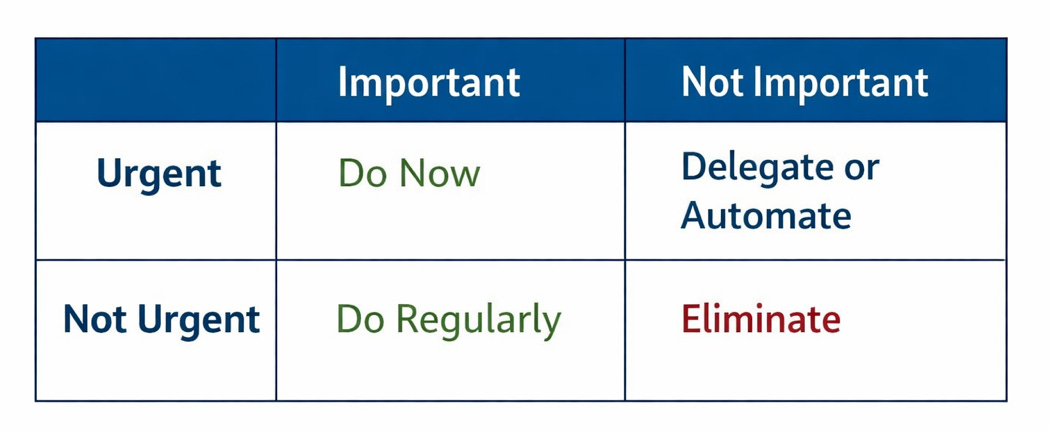
First we have the famous Eisenhower Matrix. If you’re not familiar, it has important and unimportant tasks, it has urgent and not urgent tasks in a matrix. Simple but powerful for seeing where your time actually goes.
The Pareto Principle (80/20 Rule)
80 percent of your results come from 20% of your effort. 80% of a typical company’s income comes from 20% of their customers. 20% of criminals cause 80% of crime. It’s a pattern seen all throughout life.
Here’s what matters: if you were able to focus 100% of your day on 80/20 tasks you would get 500% more results. Or, if you like to take it easy, you can spend half a day getting 250% more done. You just need to learn to focus on the right things.
$1,000/Hour Tasks
High level CEOs make one phone call to close a deal that will make or save them millions. I know people who make $10,000 or more per hour from high leverage work all the time.
The question to ask yourself: what’s the actual dollar value of the task I’m about to do?
These frameworks are all useful, but they’re also all very similar. Here's what none of these frameworks tell you.
The Counterintuitive Truth: Start Before You Prioritize
I know what you’re thinking. Shouldn’t I prioritize first, then start working? No. You need to learn the habit of starting first.
Why? Because action forces prioritization. Once you’re going you have to figure things out. Prioritizing before starting often becomes just another excuse for procrastination. Overthinking is the enemy.
Prioritizing actually becomes easier once you’re in motion. You get clarity. So it makes sense to start first anyway.
The Key Question
Once you’re moving, a great question to ask yourself is: “What’s the highest value task I can work on right now?”
Many times, just realizing what’s a waste of time at this moment is helpful.
The Simple System
Looking at our frameworks above, here’s the best practice from each:
Eliminate low value tasks that are not important. Gossip, useless busywork, doomscrolling on social media or TV. Most people find hours a day by eliminating the silly stuff in their life.
Delegate or automate the urgent things that come up that are not important. These are daily chaos things like email, bills, calls. Put bills on autopay, use filters on email, batch phone calls all at once, hire an assistant for that $10/hour work.
Focus on high value tasks, especially those that are not urgent. That’s where basically all high value, $1,000/hour+ tasks live: projects tied to your goals, building systems or strategies, learning, exercising (gives you more energy, better sleep). Many of the most high performance people on Earth focus almost exclusively on these types of tasks.
As you get more control of your time and day, you’ll notice the urgent important issues start coming up less. Fewer fires. Why? Because you’re being proactive and focusing on higher value things like systems.
Maybe you’ll make some checklists or systemize your business to prevent these issues from coming up, these fires from happening in the first place. Then you’ll have more energy to prevent them because you’re being strategic or not wasting time on low value or unimportant work.
Saying No
Ruthless prioritization, as I like to call it, because it is ruthless. Sometimes you don’t get to do what you want and many times others don’t get access to your time either.
This involves saying “no.”
A lot of people have problems with saying no, but like anything, it gets easier with practice. And there are ways to do it that sound so nice the other person doesn’t even know they got rejected:
“Oh man, I’m working on a project, can I hit you up when I’m done for a raincheck?” Bam. See how easy that was?
Derek Sivers recommends the principle of “Hell yeah! or no.” Unless it’s something you would say “hell yeah” to, pass and maintain focus on your existing priorities. Naval Ravikant takes it further: “If you can’t decide, the answer is no.”
Summary
Honestly, working on the priority can be messy sometimes. An ultra-clean desktop or workspace is not always the indication of productivity. Some things may not get done. Lower priority things will slip. That’s life. Life has tradeoffs.
Remember Goethe: “Things that matter most must never be at the mercy of things which matter least.” We want to get to the point where we focus almost exclusively on things that are in the realm of important but not urgent. Like I mentioned above, things tied to goals, systems, strategy, learning, etc.
The more time you spend working on higher value tasks, the faster you will accomplish your goals. It really is that simple.
So here’s your action rule: Work on the highest value task first. Ask yourself: “What’s the highest value task I can work on right now?”
Break the curse.
If you want a simple system to identify your highest-value tasks and actually work on them daily, that’s exactly what Zorga is built for.